The math of high-volume screening: why round one is the bottleneck
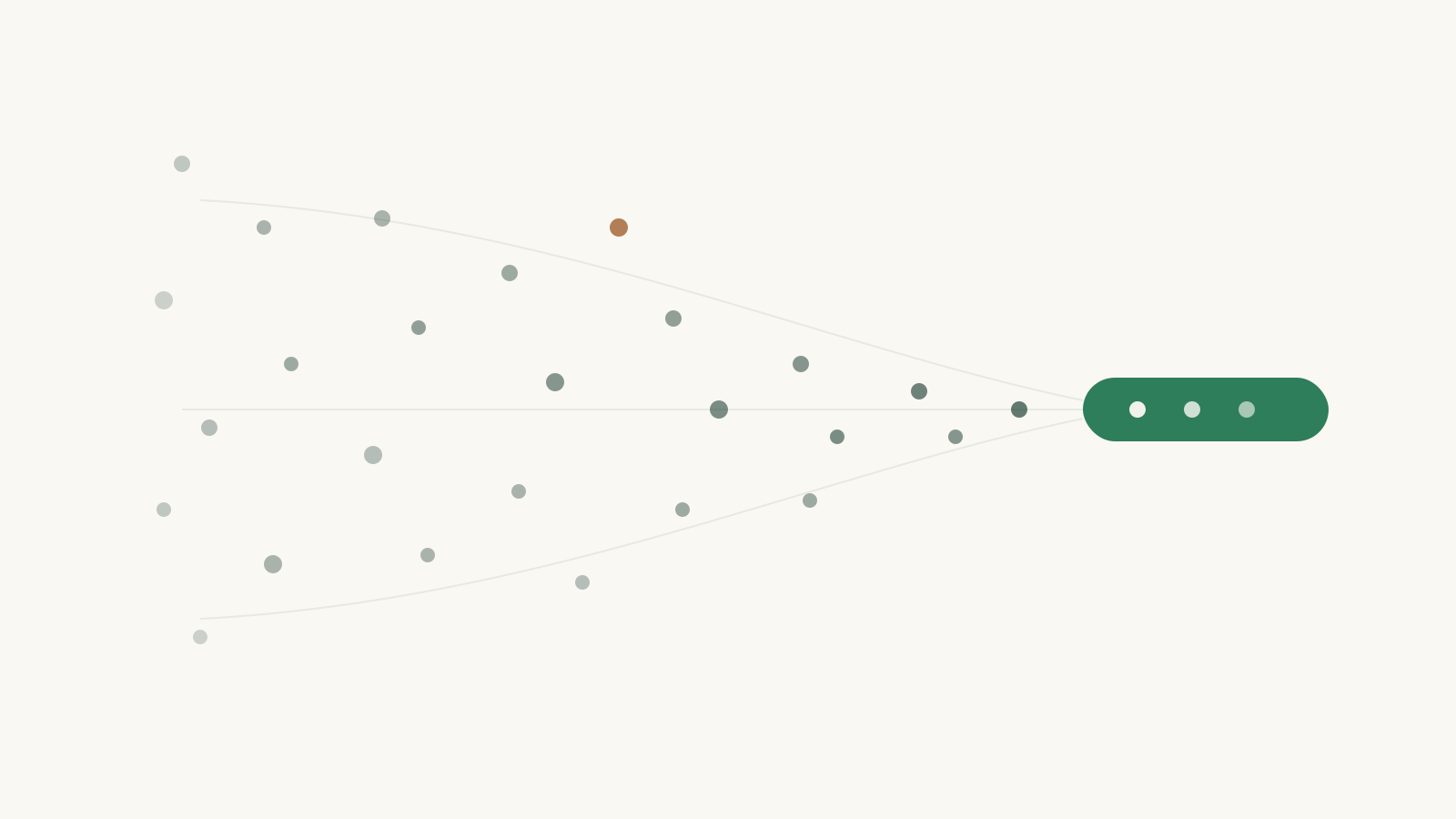
Every hiring funnel has one stage where the math simply stops working. It is not sourcing, and it is not the offer. It is the first live conversation — the 30-minute screen that stands between a pile of applications and a real shortlist.
Do the arithmetic in your head. Two hundred applicants, thirty minutes each, is one hundred hours of interviewing — before a single calendar invite goes out. That is two and a half full working weeks a recruiter spends just reaching the point where the actual evaluation can begin. And a hundred hours is the optimistic number.
The arithmetic nobody budgets for
Start with the clean version and add the friction back one layer at a time.
- The screens themselves. 200 candidates × 30 minutes = 100 hours. Halve the volume and you still owe 50.
- Scheduling. Almost no screen is booked in one message. A proposed time, a decline, a reschedule, a reminder — three or four email round-trips per candidate is normal, and each one is dead time smeared across days.
- No-shows. Some fraction of booked calls simply do not happen. Every one is a held slot that produced nothing and now has to be rebooked.
- Timezones. Spread the applicants across regions and the recruiter’s own workday becomes the ceiling: there are only so many 9-to-5 hours that overlap with everyone.
None of these are edge cases. They are the ordinary texture of high-volume screening, and they compound. The visible cost is the interviewing hours; the invisible cost is the calendar Tetris around them.
This is why the top-line hiring numbers look the way they do. SHRM’s benchmarking puts the average cost per hire at roughly $4,700 (SHRM, The Real Costs of Recruitment) and the average time to fill a role at about 33 days (SHRM, Staffing Metrics: ‘Time to Fill’). A month of open-role time and several thousand dollars a seat is not mostly the offer stage. A large share of it is the human hours the funnel burns in round one.
What the bottleneck silently costs
The screening bottleneck bills you in three currencies, and only one of them shows up on an invoice.
Speed. Every hour of screening is an hour the role stays open. While you work through the queue, the strong candidates near the top of it are interviewing elsewhere, and open-role time keeps accruing — in lost output, in overloaded teammates, in a hiring manager asking for a status you do not have.
Quality. When the queue is long, something has to give, and it is usually the interview. Screens get compressed to twenty minutes, then fifteen. Some candidates get skipped entirely and judged on a résumé — which tells you where someone worked, not how they think. The bar quietly drops, not because anyone decided to lower it, but because there were not enough hours to hold it.
Fairness. This is the one that should worry you most. When every screen is a slightly different conversation run by a tired human, the candidate booked at 10am on Tuesday and the one squeezed in at 4:55pm on Friday are not measured against the same standard. Whoever books first, or catches the recruiter fresh, gets a better hearing — and that has nothing to do with who would do the job better. Consistency is not a nicety here; it is the entire basis for comparing people at all. That is the case for structured interviews at scale: when every interview differs, you are comparing interviews, not candidates.
Async voice changes the constraint, not the standard
The bottleneck exists because round one assumes a human has to be present, live, for every conversation. Relax that one assumption and the arithmetic changes completely.
An asynchronous voice interview is a natural, 8–10 minute conversation the candidate takes from a browser link — no app, no account, no scheduling. They start it at 7am before work or at 11pm once the house is quiet; the interviewer is available at every hour and in every timezone at once. Two hundred candidates can all interview on the same Tuesday without a single one landing on the recruiter’s calendar.
Here is the part that matters, and the part cheap tools get wrong: the standard does not move. Every candidate gets the same rubric-driven conversation, authored from the role, covering the same competencies to the same depth. What does not change is the evaluation itself — the rubric, the evidence bar, and the human who makes the decision. The interview scores the content of what a candidate says, anchored to citable moments in the transcript. It does not analyze voice, tone, accent, or emotion — none of that touches a score, by design. You are removing the scheduling constraint, not lowering the bar. Those are different things, and it is easy to sell one as the other.
The math after
Run the same 200 applicants through it.
Round one now costs the recruiter zero interviewing hours. The hundred hours of live screening, the scheduling round-trips, the no-shows, the timezone Tetris — that entire column goes to zero, because the conversations happen without anyone booking them or sitting through them.
The recruiter’s time does not vanish; it moves. Instead of conducting two hundred interviews, they review two hundred evidence-backed scorecards — each a few minutes to read, each pointing to the exact transcript moments behind its ratings — and then spend their real, expensive human hours where those hours are worth the most: in live conversation with the shortlist that actually earned one.
That is the whole trade. The same standard, applied to everyone, with the human judgment moved to the end of the funnel instead of being rationed across the front of it. Nothing here promises a magic number — just arithmetic. One hundred hours of round-one screening becomes zero, and the hours you keep get spent on the candidates who are worth them.
Where this leaves round one
The first-round bottleneck was never really about interviewing. It was about a human having to be in every conversation, live, before the evaluation could even start. Take that constraint away and keep the standard, and round one stops being the stage where the math breaks.
For what a short voice interview can — and cannot — honestly tell you about a candidate, read what a 10-minute voice interview tells you.